
NCERT Class 12 Maths Chapter 1 Miscellaneous Exercise solution
Q.1. NCERT Class 12 Maths Chapter 1 Miscellaneous Exercise solution
\begin{array}{l}
Q.1.\ \ Show\ that\ the\ function\ f:R\rightarrow {x\in R- 1< x< 1} \ defined\ by\ f( x) =\ \frac{x}{1+|x|} ,\ x\in R\ is\ one-one\ and\ onto\ function.\\ Solution:\ To\ show\ one-one:\ Case\ 1.\ Both\\ x_{1} ,x_{2} \ greater\ than\ or\ equal\ to\ 0\ Let\ us\ assume\ f( x_{1}) =f( x_{2}) \ ;\ \ x_{1} ,x_{2} \\ greater\ than\ or\ equal\ to\ 0.\ \Longrightarrow \frac{x_{1}}{1+x_{1}} =\frac{x_{2}}{1+x_{2}}\\\Longrightarrow x_{1} +x_{1} x_{2} =x_{2} +x_{1} x_{2}\ \Longrightarrow x_{1} =x_{2}\\ \Longrightarrow It\ is\ one-one.\ Case\ 2:\ Both\ x_{1} ,x_{2} < 0\ f( x_{1}) =f( x_{2})\\ \Longrightarrow \frac{x_{1}}{1-x_{1}} =\frac{x_{2}}{1-x_{2}}\ \Longrightarrow x_{1} -x_{1} x_{2} =x_{2} -x_{1} x_{2}\ \Longrightarrow x_{1} =x_{2}\\ \Longrightarrow It\ is\ one-one\ Case\ 3:\ x_{1} >0,\ x_{2} < 0\ or\ vice-versa\ Ifx_{1} >0,\ f( x_{1}) >0.\ If\ x_{2} < 0\ then\ f( x_{2}) < 0.\\ Thus,\ f( x_{1}) \neq f( x_{2})\\ So,\ this\ case\ is\ not\ possible.\\ Therefore,\ considering\ valid\ cases,\ f\ is\\ one-one.\ On-to\ or\ Surjective:\ If\ y\ is\ greater\ than\ or\ equal\ to\ 0:\ Let\ y=f( x)\\ \Longrightarrow y=\frac{x}{1+x}\ \Longrightarrow y+yx=x\ \Longrightarrow x=\frac{y}{1-y} .\\ Since\ 0< y< 1,\ 1-y >0,\\
For\ every\ y\in 0< y< 1,\ there\ exists\ x\ and\ hence\ it\ is\ surjective.\ Ify< 0,\ y=\frac{x}{1-x}\\ \Longrightarrow x=\frac{y}{1+y}\ As\ y >-1,\ so\ x\ is\ well\ defined.\\
\
Therefore,\ f\ is\ surjective.
\end{array}
Q.2. NCERT Class 12 Maths Chapter 1 Miscellaneous Exercise solution
\begin{array}{l}
Q.2.\ Show\ that\ the\ function\ f:R\rightarrow R\ given\ by\ f( x) =x^{3} \ is\ injective.\\
Solution:\\
Let\ f( x_{1}) =f( x_{2}) ,\ x_{1} ,\ x_{2} \ \in R\\
\Longrightarrow x_{1}^{3} =x_{2}^{3}\\
\Longrightarrow x_{1} =x_{2}\\
\Longrightarrow \ f\ is\ injective.\\
\end{array}
Q.3. NCERT Class 12 Maths Chapter 1 Miscellaneous Exercise solution
\begin{array}{l}
Q.3.\ \ Given\ a\ non-empty\ set\ X,\ consider\ P( X) \ which\ is\ the\ set\ of\ all\ subsets\ of\ X.\\
Define\ the\ relationR\ in\ P( X) \ as\ follows:\\
For\ subsets\ A,\ B\ in\ P( X) ,\ ARB\ if\ and\ only\ if\ A\subset B.\ Is\ R\ an\ equivalence\ relation\ on\ P( X) ?\\
Justify\ your\ answer.\\
Solution:\\
Reflexivity:\ For\ any\ set\ A\in P( X) ,\\
A\subset A\ ( Every\ set\ is\ subset\ of\ itself) .\\
So,\ ARA\ is\ true.\\
\Longrightarrow it\ is\ reflexive.\\
Symmetric:\\
A\ relation\ is\ symmetric\ if\ ARB\Longrightarrow BRA.\ \\
For\ subsets\ A,B\in P( X) ,\ A\subset B\ does\ not\ necessarilyt\ imply\ B\subset A.\\
For\ example,\ if\ X={1,2,3} \ A={1,2} ,\ and\ B={1,2,3} \ then\ A\subset B\ ( ARB)\\
But\ B\ is\ not\ a\ subset\ of\ A,\ So\ B\ is\ not\ related\ to\ A.\\
\Longrightarrow it\ is\ not\ symmetric.\\
Transitive:\ If\ ARB\ ( A\subset B) \ and\ BRC\ ( B\subset C) \ then\ A\subset C\\
\Longrightarrow ARC\ is\ true.\\
Hence,\ it\ is\ transitive.\\
Since\ it\ is\ reflexive\ and\ transitive\ but\ not\ a\ symmetric\ relation.\\
Therefore,\ it\ is\ not\ an\ equivalence\ relation.
\end{array}
Q.4. NCERT Class 12 Maths Chapter 1 Miscellaneous Exercise solution
\begin{array}{l}
Q.4.\ \ Find\ the\ number\ of\ all\ onto\ functions\ from\ the\ set\ {1,2,3,………,n} \ to\ itself.\\
Solution:\\
For\ every\ element\ in\ the\ given\ set,\ there\ must\ be\ preimage\ in\ the\ same\ set.\ \ \\
So,\ for\ the\ first\ element,\ say\ 1,\ it\ has\ n\ choices,\ the\ second\ element\ has\ n-1\ choices\\ and\ so\ on.\\
Therefore\ total\ number\ of\ onto\ functions\ is:\\
n( n-1)( n-2) ……….3.2.1\ =n!
\end{array}
Q.5. NCERT Class 12 Maths Chapter 1 Miscellaneous Exercise solution
\begin{array}{l}
Q.5.\ \ Let\ A={-1,0,1,2} \ B={-4,-2,0,2} \ and\\ f,g:\ A\rightarrow B\ be\ functions\ defined\ by\\
f( x) =x^{2} -x,\ x\in A\ and\ g( x) =2|x-\frac{1}{2} |-1,\ x\in A.\ Are\ f\ and\ g\ equal?\ Justify\\ your\\
answer.\\
Solution:\\
We\ have\ f( x) =x^{2} -x,\ x\in A\\
So,\ f( -1) =( -1)^{2} -( -1) =1+1=2\ ,\ we\ get\ ( -1,2)\\
f( 0) =0^{2} -0=0,\ \ We\ get\ ( 0,0)\\
f( 1) =1^{2} -1=0,\ we\ get\ ( 1,0)\\
f( 2) =2^{2} -2=2,\ we\ get\ ( 2,2)\\
Now,\ g( x) =2|x-\frac{1}{2} |-1\\
\Longrightarrow g( -1) =2|-1-\frac{1}{2} |-1=2|-\frac{3}{2} |-1=2,\ we\ get\ ( -1,2)\\
g( 0) =0\ we\ get\ ( 0,0)\\
g( 1) =0\ we\ get\ ( 1,0)\\
g( 2) =2|2-\frac{1}{2} |-1=2\times \frac{3}{2} -1=2\ we\ get\ ( 2,2)\\
We\ see\ for\ all\ x\in A,\ f( x) =g( x) .\ Thus\ f\ and\ g\ are\ equal.
\end{array}
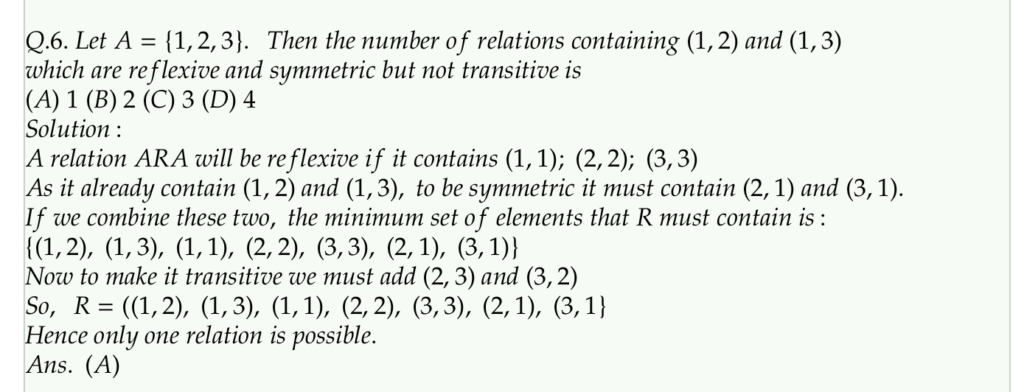
Q.6. NCERT Class 12 Maths Chapter 1 Miscellaneous Exercise solution
Q.7. NCERT Class 12 Maths Chapter 1 Miscellaneous Exercise solution
\begin{array}{l}
Q.7.\ Let\ A={1,2,3} .\ \ Then\ number\ of\ equivalence\ relations\ containing( 1,2) \ is\\
( A) \ 1\ ( B) \ 2\ ( C) \ 3\ ( D) \ 4\\
Solution:\ To\ be\ reflexive\ we\ must\ have\ ( 1,1) ,\ ( 2,2) ,\ ( 3,3)\\
To\ be\ symmetric\ \ we\ must\ have\ ( 2,1) \ as\ we\ already\ have\ ( 1,2) .\\
To\ be\ transitive\ we\ have\ ( a,b) \in R\ and\ ( b,c) \in R\ then\ ( a,c) \in R\\
So\ for\ an\ equivalence\ relation\ the\ first\ relation\ we\ can\ consider:\\
R_{1} ={( 1,1) ,\ ( 2,2) ,\ ( 3,3) ,\ ( 1,2) ,\ ( 2,1)}\\
[ for\ transitivity\ we\ have\ ( 1,2) ,\ ( 2,1) ,\ ( 1,1)]\\
R_{2} ={( 1,1) ,\ ( 2,2) ,\ ( 3,3) ,\ ( 1,2) ,\ ( 2,1) ,\ ( 2,3) ,\ ( 3,2)( 1,3)}\\
Only\ these\ 2\ relations\ are\ possible.\\
Ans.\ ( B)
\end{array}
NCERT Class 12 Maths Chapter 1 Miscellaneous Exercise solution
The NCERT Class 12 Maths Chapter 1 Miscellaneous Exercise Solutions have been prepared keeping in mind the Relations and Functions Chapter 1 topic of Class 12 Maths. This exercise combines application-based questions and logical questions. Throughout this chapter, practice solutions are provided to develop problem-solving skills and a deeper understanding. We have tried to provide step-by-step solutions to make it easy for students to understand, and we hope to meet your expectations.
Class 12 maths NCERT ch1 miscellaneous ex. Solution
This well-explained NCERT Class 12 Maths Chapter 1 Miscellaneous Exercise Solution helps students deepen their understanding of relations and functions. Prepared with correct methodology and step-by-step explanations, it covers all important steps and patterns necessary for CBSE board exams. Regular practice with this solution will also help students build confidence.
Frequently Asked Questions (FAQs)
Q1. Why is the NCERT Class 12 Maths Chapter 1 Miscellaneous Exercise important?
NCERT Class 12 Maths Chapter 1 Miscellaneous Exercise Solutions are important for clearing your concepts and scoring well in the board exams.
Q.2. Are NCERT solutions enough for board exam preparation?
NCERT book has been developed and designed to keep board exam preparation. It is specifically meant to CBSE curriculum. So, yes, NCERT solution is the most important for CBSE students.
Q.3. Do these solutions follow the latest CBSE syllabus?
Yes, These solutions strictly for the latest CBSE syllabus.
Q.4. How should students use miscellaneous exercise solutions effectively?
Miscellaneous exercise of NCERT is designed to revise the whole chapter and Important Questions are placed in this exercise. So, the miscellaneous exercise solution definitely going to help students in the preparation for the board exams.
Q.5. Are step-by-step solutions necessary?
Yes, step-by-step preparation is necessary for the 12th board exams.

