
What is a continuity of a function?
$\displaystyle \begin{array}{{>{\displaystyle}l}}
What\ is\ continuity\ of\ a\ function?\\
Definition:\ 1.\ A\ function\ is\ said\ to\ be\ continuous\ if\\
lim\ \ \ \ \ f( x) =f( a) \in R\ then\ f( x) \ is\ continuous\ at\ x=a\\
x\rightarrow a
\end{array}$
Working Rule to Check Continuity of a Function
Working Rule:
Put the value of the limit in the function i.e. for a function with a variable x put x= a in place of x and if you get a constant (Real Number), then it is continous at that point.
Definition 2: Continuity of a function
Definition:2. A function is said to be continuous at x=a if its Left Hand Limit and Right Hand Limit are equal to the value of function at x=a i.e. f(a).
$\displaystyle \begin{array}{{>{\displaystyle}l}}
lim\ \ \ \ \ f( x) =lim\ \ \ \ \ \ f( x) =f( a) \ \\
x\rightarrow a^{-} \ \ \ \ \ \ \ \ \ \ x\rightarrow a^{+}\\
LHL=RHL=f( a)
\end{array}$
Explanation: Here x$\displaystyle \rightarrow a^{-\ } means\ we\ are\ approaching\ to\ a\ point\\ a\ from\ left\ hand\ side.$
-(negitive sign) just indicates we are approching from left hand side to ‘a’.
x$\displaystyle \rightarrow a^{+} \ means\ we\ are\ approaching\ to\ a\ point\ a\ from\ right\\ hand\ side.\ $
+(positive sign) indicates we are approaching right hand side to ‘a’.
Geometrical Meaning of the Continuity of a Function:
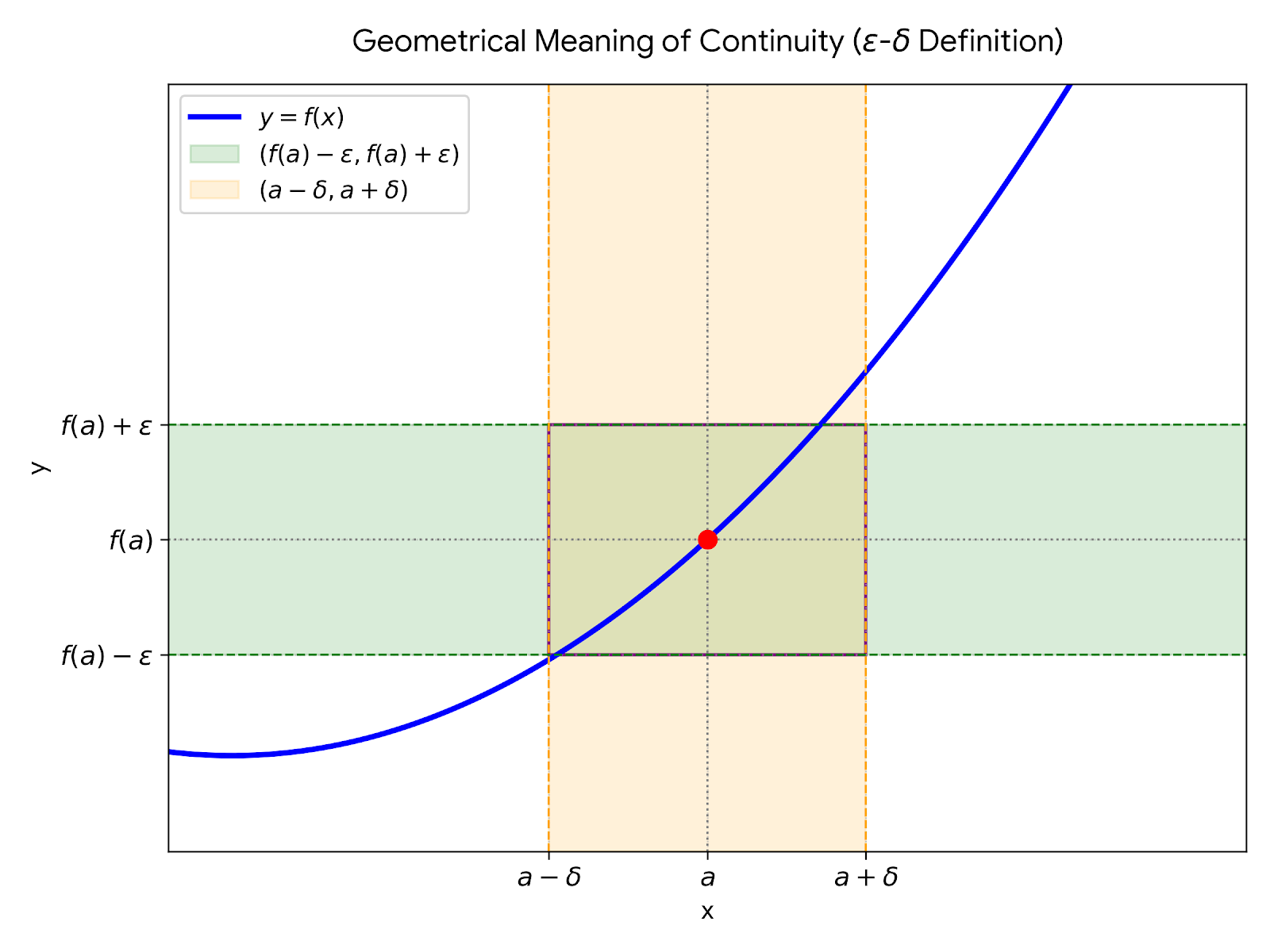
Let us consider a point x=a, if we are able to move [a,f(a)] without lifting the pen, then function is said to be continuous at that point.
Illustrations/Examples for the continuity of a Function:
Example 1. Check continuity of the function $\displaystyle f( x) =\ x^{2} \ at\ x=2$
$\displaystyle \begin{array}{{>{\displaystyle}l}}
\rightarrow f( 2) =4\\
\rightarrow lim\ \ \ \left( x^{2}\right) =\ 2^{2} =4\\
\ \ \ \ \ x\rightarrow 2\\
Therefore\ f( x) \ is\ continuous.
\end{array}$
Example 2: continuity of a function
Example 2. Removal dicontinuity (hole):
$\displaystyle \begin{array}{{>{\displaystyle}l}}
f( x) \ =\ \frac{x^{2} -4}{x-2} \ at\ x=2.\\
\rightarrow f( 2) \ gives\ indeterminate\ form\ i.e.\ \frac{0}{0} .\\
Solving\ limits\\
lim\ \ \ \ \ f( x) \ =lim\ \ \ \ \left(\frac{x^{2} -4}{x-2}\right)\\
x\rightarrow 2\ \ \ \ \ \ \ \ \ \ \ \ \ \ x\rightarrow 2\\
=\ lim\ \ \ \ \frac{( x-2)( x+2)}{( x-2)} =2+2=4.\\
\ \ \ \ \ \ x\rightarrow 2\\
Since\ f( 2) \ is\ not\ defined\ at\ x=2,\ It’s\ discontinuous\ -\ a\ hole\ at\ ( 2,4)\\
\end{array}$
Example 3. Continuity of a function
Example 3. Jump Discontinuity:
f(x)=1 for x<0, f(x)=2 for x⩾0
→Left Hand Limit (LHL) at x=0 : 1
→Right Hand Limit (RHL) at x=0 : 2
$\displaystyle \begin{array}{{>{\displaystyle}l}}
LHL\neq RHL\\
\therefore \ f( x) \ is\ discontinuous\ at\ x=0.
\end{array}$
Example 4. Continuity of a function
Example 4. Peicewise, testing continuity at a boundary:
$\displaystyle \begin{array}{{>{\displaystyle}l}}
f( x) ={x+1\ for\ x\leqslant 3\\
\ \ \ \ \ \ \ \ \ \ \ \ {2x-2\ for\ x >3.\\
\end{array}$
→LHL at x=3 : 3+1=4
→RHL at x=3: 2(3)-2=4
→ f(3)=4
$\displaystyle \begin{array}{{>{\displaystyle}l}}
\therefore LHL=RHL=f( 3)\\
hence\ f( x) \ is\ continuous\ at\ x=3.
\end{array}$
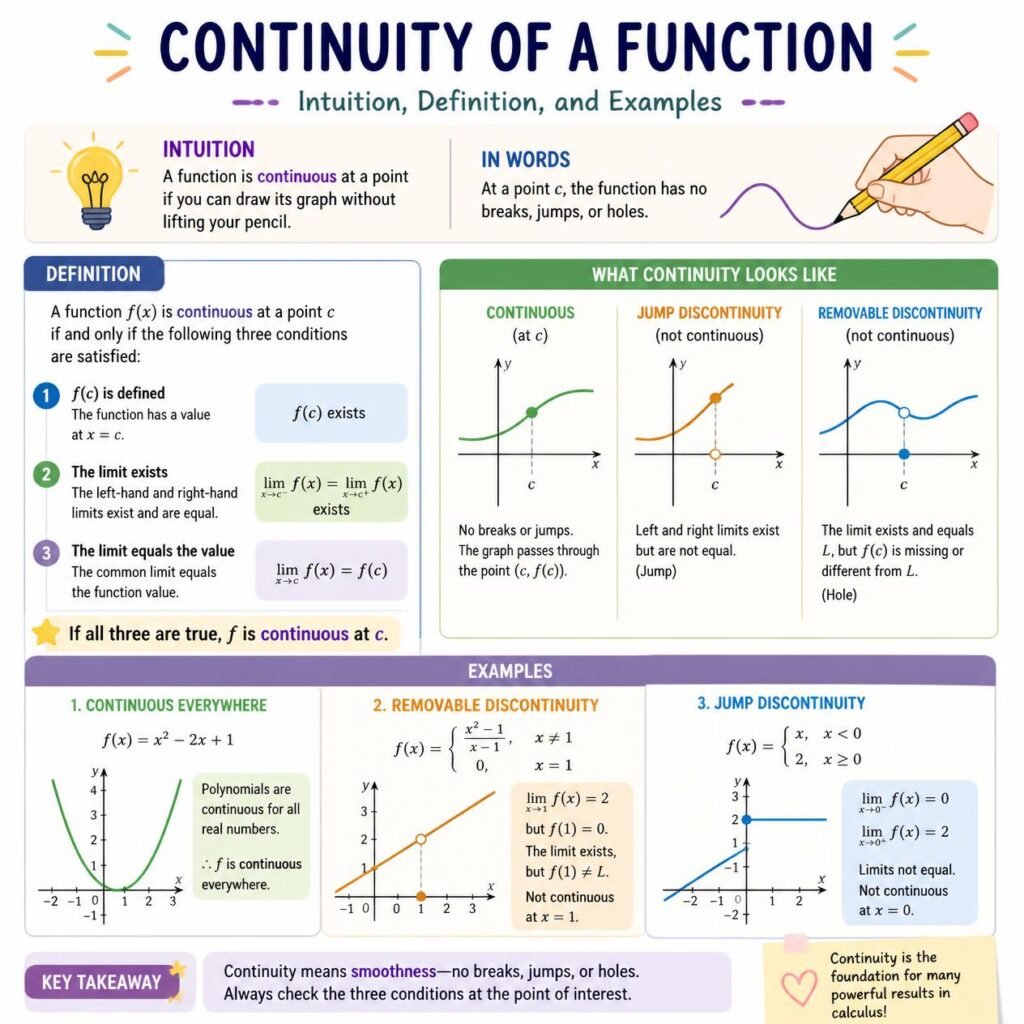
Example 5. To prove continuity of a function
Example 5. A function f(x) is defined as,
f(x)= $\displaystyle {$$\displaystyle \begin{array}{{>{\displaystyle}l}}
\frac{x^{2} -x-6}{x-3} ,\ if\ x\neq 3\\
5\ \ \ \ \ \ \ \ \ \ \ \ \ \ ,\ if\ x=3
\end{array}$
Show that f(x) is continuous at x=3.
Solution: We need to check the continuity of the function at x=3.
LHL= $\displaystyle \begin{array}{{>{\displaystyle}l}}
lim\ \ \ \ \ \ \ f( x) \ =\ lim\ \ f( 3-h)\\
x\rightarrow 3^{-} \ \ \ \ \ \ \ \ \ \ \ \ \ \ h\rightarrow 0
\end{array}$
$\displaystyle \begin{array}{{>{\displaystyle}l}}
=lim\ \ \ \ \ \frac{( 3-h)^{2} -( 3-h) -6}{3-h-3}\\
\ \ \ \ \ h\rightarrow 0\\
=lim\ \ \ \frac{9+h^{2} -6h-3+h-6}{-h}\\
\ \ \ \ h\rightarrow 0\\
=lim\ \ \ \ \frac{h^{2} -5h}{-h} =\frac{h( h-5)}{-h} =5\\
\ \ \ \ h\rightarrow 0
\end{array}$
RHL= $\displaystyle \begin{array}{{>{\displaystyle}l}}
lim\ \ \ \ \ \ \ f( x) \ =\ lim\ f( 3+h)\\
x\rightarrow 3^{+} \ \ \ \ \ \ \ \ \ \ \ \ \ \ h\rightarrow 0
\end{array}$
\ \ \ \ \ \ $\displaystyle \begin{array}{{>{\displaystyle}l}}
=\ lim\ \ \ \frac{( 3+h)^{2} -( 3+h) -6}{3+h-3} =\ lim\ h+5\ =5\\
\ \ \ \ \ h\rightarrow 0\ \ \ \ \ \ \ \ \ \ \ \ \ \ \ \ \ \ \ \ \ \ \ \ \ \ \ \ \ \ \ \ \ \ \ \ \ \ \ \ \ h\rightarrow 0
\end{array}$
Thus, LHL=RHL=f(3)
Hence f(x) is continuous at x=3
Proved.
Example 5. To check continuity of a function
Example 6. If F(x)= {$\displaystyle \begin{array}{{>{\displaystyle}l}}
\frac{sin3x}{x} ;\ when\ x\neq 0\\
1\ \ \ \ \ \ \ ;\ when\ x=0
\end{array}$
find whether f(x) is continuous at x=0.
Solution:
$\displaystyle \begin{array}{{>{\displaystyle}l}}
Lim\ \ \ f( x) \ =\ lim\ \ \frac{sin3x}{3x} \times 3=1\times 3=3\\
x\rightarrow 0^{-} \ \ \ \ \ \ \ \ \ \ \ \ x\rightarrow 0
\end{array}$
$\displaystyle \begin{array}{{>{\displaystyle}l}}
lim\ \ \ f( x) =lim\ \ \ \ \ \frac{sin\ 3x}{3x} \times 3=3\\
x_{\rightarrow 0^{+}} \ \ \ \ \ \ \ \ \ \ \ x\rightarrow 0^{+}
\end{array}$
f(0)=1
Thus LHL=RHL$\displaystyle \neq $f(0)
Therefore, f(x) is discontinuous at x=0.
It is a removable discontinuity.

