
Class 12 Maths Misc. Ex. Ch 3 Matrices Solution
NCERT BOOK CHAPTER 3 MATRICES PDF
Q.1. Class 12 Maths Misc. Ex. Ch 3 Matrices Solution
Q.1. If A and B are symmetric matrices, prove that AB-BA is a skew symmetric matrix.
\begin{array}{l}
Solution:\ A\ and\ B\ are\ symmetric\ matrices.\\
\Longrightarrow A’=A\ and\ B’=B\\
Now\ ( AB-BA) ‘=( AB) ‘-( BA) ‘\\
=B’A’-A’B’\\
=BA-AB\ [ As\ A\ and\ B\ are\ symmetric\ matrices.]\\
=-( AB-BA)\\
Hence,\ AB-BA\ is\ a\ skew\ symmetric\ matrix
\end{array}
Q.2. Class 12 Maths Misc. Ex. Ch 3 Matrices Solution
Q.2. Show that the Matrix B’AB is symmetric or skew symmetric
according as A is symmetric or skew symmetric.
$\displaystyle \begin{array}{{>{\displaystyle}l}}
Solution:\ Case\ I\ -\ Let\ A\ is\ a\ symmetric\ matrix.\\
Then,\ A’=A\\
Now,\ ( B’AB) ‘=( AB) ‘( B’) ‘\\
=B’A’B\ \ \ \ (( B’) ‘=B)\\
=B’AB\ \ ( Using\ A’=A)\\
Hence\ B’AB\ is\ a\ symmetric\ matrix.\\
CaseII-Let\ A\ is\ a\ skew\ symmetric\ matrix.\\
Then,\ A’=-A\\
( B’AB) ‘=( AB) ‘( B’) ‘\\
=B’A’B\ \ \ ( B”=B)\\
=B'( -A) B=-B’AB\\
Hence\ B’AB\ is\ skew\ symmetric\ matrix.
\end{array}$
Q.3. Class 12 Maths Misc. Ex. Ch 3 Matrices Solution
Q.3. Find the values of x, y, z if the matrix
A=$\displaystyle {\displaystyle \begin{bmatrix}
0 & 2y & z\\
x & y & -z\\
x & -y & z
\end{bmatrix} \ satisfy\ the\ equation\\\ A’A=I}$
$\displaystyle \begin{array}{{>{\displaystyle}l}}
Solution:\ We\ have\ A=\begin{bmatrix}
0 & 2y & z\\
x & y & -z\\
x & -y & z\\
\end{bmatrix}\\\
A’A=\begin{bmatrix}
0 & x & x\\
2y & y & -y\\
z & -z & z
\end{bmatrix}\begin{bmatrix}
0 & 2y & z\\
x & y & -z\\
x & -y & z
\end{bmatrix}\\
=\begin{bmatrix}
0+x^{2} +x^{2} & 0+xy-xy & 0-xz+xz\\
0+xy-xy & 6y^{2} & 0\\
0 & 0 & 3z^{2}
\end{bmatrix}\\
=\begin{bmatrix}
2x^{2} & 0 & 0\\
0 & 5y^{2} & 0\\
0 & 0 & 3z^{2}
\end{bmatrix}\\
A’A=I\\
So,\ \begin{bmatrix}
2x^{2} & 0 & 0\\
0 & 6y^{2} & 0\\
0 & 0 & 3z^{2}
\end{bmatrix} =\begin{bmatrix}
1 & 0 & 0\\
0 & 1 & 0\\
0 & 0 & 1
\end{bmatrix}\\
Equating\ corresponding\ elements\\
2x^{2} =1\\
x^{2} =\frac{1}{2}\\
\Longrightarrow x=\pm \frac{1}{\sqrt{2}}\\
6y^{2} =1\\
\Longrightarrow y^{2} =\frac{1}{6}\\
\Longrightarrow y=\pm \frac{1}{\sqrt{6}}\\
3z^{2} =1\\
\Longrightarrow z^{2} =\frac{1}{3}\\
\Longrightarrow z=\pm \frac{1}{\sqrt{3}}
\end{array}$
Q.4. Class 12 Maths Misc. Ex. Ch 3 Matrices Solution
Q.4. For what values of x: $\displaystyle \begin{bmatrix}
1 & 2 & 1
\end{bmatrix}\begin{bmatrix}
1 & 2 & 0\\
2 & 0 & 1\\
1 & 0 & 2
\end{bmatrix}\begin{bmatrix}
0\\
2\\
x
\end{bmatrix} =0?$
$\displaystyle \begin{array}{{>{\displaystyle}l}}
Solution:\ \begin{bmatrix}
1+4+1 & 2+0+0 & 0+2+2
\end{bmatrix}\begin{bmatrix}
0\\
2\\
x
\end{bmatrix} =0\\
\Longrightarrow \begin{bmatrix}
6 & 2 & 4
\end{bmatrix}\begin{bmatrix}
0\\
2\\
x
\end{bmatrix} =0\\
\Longrightarrow 4+4x=0\\
\Longrightarrow x=-1.
\end{array}$
Q.5. Class 12 Maths Misc. Ex. Ch 3 Matrices Solution
Q. 5. If A=$\displaystyle \begin{bmatrix}
3 & 1\\
-1 & 2
\end{bmatrix} ,\ Show\ that\ A^{2} -5A+7I=0$
$\displaystyle \begin{array}{{>{\displaystyle}l}}
Solution:\ A^{2} =\begin{bmatrix}
3 & 1\\
-1 & 2
\end{bmatrix}\begin{bmatrix}
3 & 1\\
-1 & 2
\end{bmatrix}\
=\begin{bmatrix}
8 & 5\\
-5 & 3
\end{bmatrix}\\
5A=\begin{bmatrix}
15 & 5\\
-5 & 10
\end{bmatrix}\
7I=\begin{bmatrix}
7 & 0\\
0 & 7
\end{bmatrix}\\
A^{2} -5A+7I\\
=\begin{bmatrix}
8 & 5\\
-5 & 3
\end{bmatrix} -\begin{bmatrix}
15 & 5\\
-5 & 10
\end{bmatrix} +\begin{bmatrix}
7 & 0\\
0 & 7
\end{bmatrix}\\
=\begin{bmatrix}
0 & 0\\
0 & 0
\end{bmatrix}\\
Hence\ proved.
\end{array}$
Q.6. Class 12 Maths Misc. Ex. Ch 3 Matrices Solution
Q.6. Find x, if $\displaystyle \begin{bmatrix}
x & -5 & -1
\end{bmatrix}\begin{bmatrix}
1 & 0 & 2\
0 & 2 & 1\
2 & 0 & 3
\end{bmatrix}\begin{bmatrix}
x\
4\
1
\end{bmatrix} =0$
$\displaystyle \begin{array}{{>{\displaystyle}l}}
Solution:\ \begin{bmatrix}
x & -5 & -1
\end{bmatrix}\begin{bmatrix}
1 & 0 & 2\\
0 & 2 & 1\\
2 & 0 & 3
\end{bmatrix}\begin{bmatrix}
x\\
4\\
1
\end{bmatrix} =0\\
\Longrightarrow \begin{bmatrix}
x-2 & -10 & 2x-8
\end{bmatrix}\begin{bmatrix}
x\\
4\\
1
\end{bmatrix} =0\\
\Longrightarrow x^{2} -2x-40+2x-8=0\\
\Longrightarrow x^{2} -48=0\\
\Longrightarrow x^{2} =48\\
\Longrightarrow x=\pm 4\sqrt{3}
\end{array}$
Q.7. Class 12 Maths Misc. Ex. Ch 3 Matrices Solution
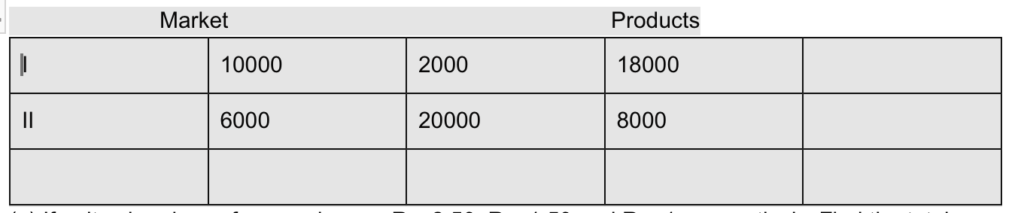
Q.7. \ A manufacturer produces three products x,y,z which he sells in two markets. \ Annual sales are indicated below:
(a) If unit sale prices of z, y and z are, Rs. 2.50, Rs. 1.50 and Re. 1, respectively. Find the total revenue in each market with the help of matrix algebra.
(b) If the unit costs of the above three commodities are Rs. 2.00, Rs. 1.00 and 50 paise respectively. \ Find the gross profit.
$\displaystyle \begin{array}{{>{\displaystyle}l}}
Solution:\ Let\ the\ matrix\ representing\ annual\ sales\ vaules\ be\ P\ and\ the\ matrix\\ representing\\
unit\ sale\ price\ be\ R.\\
P=\ \begin{bmatrix}
10000 & 2000 & 18000\\
6000 & 20000 & 8000
\end{bmatrix} \ R=\begin{bmatrix}
2.50\\
1.50\\
1.00
\end{bmatrix}\
PR=\begin{bmatrix}
Revenue\ from\ Market\ I\\
Revenue\ from\ Market\ II
\end{bmatrix} =\begin{bmatrix}
25,000+3000+18000\\
15000+30000+8000
\end{bmatrix}\\
=\begin{bmatrix}
46,000\\
53,000
\end{bmatrix}\\
Hence,\ the\ revenue\ from\ market\ I\ is\ 46,000\ and\ the\ revenue\ from\ market\ II\ is\ 53,000.\\
( b) \ Let\ the\ cost\ matrix\ C=\ \begin{bmatrix}
2\\
1\\
0.5
\end{bmatrix}\\
PC=\ \begin{bmatrix}
10000 & 2000 & 18000\\
6000 & 20000 & 8000
\end{bmatrix}\begin{bmatrix}
2\\
1\\
0.5
\end{bmatrix}\\
=\begin{bmatrix}
31000\\
36000
\end{bmatrix}\\
Profit\ collected\ from\ two\ markets\ =\ PR-PC\\
\Longrightarrow \begin{bmatrix}
46000\\
53000
\end{bmatrix} -\begin{bmatrix}
31000\\
36000
\end{bmatrix}\\
=\begin{bmatrix}
15000\\
17000
\end{bmatrix}\\
Hence\ the\ gross\ profit\ from\ both\ the\ market\
=15,000+17,000=Rs.\ 32,000.
\end{array}$
Q.8. Class 12 Maths Misc. Ex. Ch 3 Matrices Solution
Q.8. Find the matrix X so that \ X$\displaystyle \begin{bmatrix}
1 & 2 & 3\\
4 & 5 & 6
\end{bmatrix} =\begin{bmatrix}
-7 & -8 & -9\\
2 & 4 & 6
\end{bmatrix}$
$\displaystyle \begin{array}{{>{\displaystyle}l}}
Solution:\ Matrix\ X\ must\ be\ a\ 2\times 2\ matrix\ as\ Second\ matrix\ is\ 2\times 3\\
\ and\ product\ outcome\ is\ 2\times 3.\\
So,\ let\ matrix\ X\ =\ \begin{bmatrix}
x & y\\
z & t
\end{bmatrix}\\
Now,\ \begin{bmatrix}
x & y\\
z & t
\end{bmatrix}\begin{bmatrix}
1 & 2 & 3\\
4 & 5 & 6
\end{bmatrix} =\begin{bmatrix}
-7 & -8 & -9\\
2 & 4 & 6
\end{bmatrix}
\end{array}$
Multitplying LHS and equating with the corresponding
elements of RHS,
x+4y=-7; 2x+5y=-8; z+4t=2; 3z+6t=6
Solving them we get, X=$\displaystyle \begin{bmatrix}
1 & -2\\
2 & 0
\end{bmatrix}$
Q.9.
Q.9. Choose the correct answer:
If A=$\displaystyle \begin{array}{{>{\displaystyle}l}}
\begin{bmatrix}
\alpha & \beta \\
\gamma & -\alpha
\end{bmatrix} \ is\ such\ that\ A^{2} =I,\ then\\
( A) \ 1+\alpha ^{2} +\beta \gamma =0\ \ \ ( B) \ 1-\alpha ^{2} +\beta \gamma =0\\
( C) \ 1-\alpha ^{2} -\beta \gamma =0\ \ \ \ ( D) \ 1+\alpha ^{2} -\beta \gamma =0
\end{array}$
$\displaystyle \begin{array}{{>{\displaystyle}l}}
Solution:\ Given\ that:\ A^{2} =I\\
\begin{bmatrix}
\alpha & \beta \\
\gamma & -\alpha
\end{bmatrix}\begin{bmatrix}
\alpha & \beta \\
\gamma & -\alpha
\end{bmatrix} =\begin{bmatrix}
1 & 0\\
0 & 1
\end{bmatrix}\\
\Longrightarrow \begin{bmatrix}
\alpha ^{2} +\beta \gamma & 0\\
0 & \beta \gamma +\alpha ^{2}
\end{bmatrix} =\begin{bmatrix}
1 & 0\\
0 & 1
\end{bmatrix}\\
\Longrightarrow \alpha ^{2} +\beta \gamma =1\\
\Longrightarrow 1-\alpha ^{2} -\beta \gamma =0
\end{array}$
Q.10
Q.10. \ If the matrix A is both symmetric and skew symmetric then:
(A) A is a diagonal matrix (B) A is a zero matrix
(C) A is a square matrix (D) None of these
$\displaystyle \begin{array}{{>{\displaystyle}l}}
Solution:\ Since\ A\ is\ skew\ symmetric\ matrix.\\
A’=-A\\
But\ A\ is\ symmetric\ also.\\
Hence,\ A=-A\\
\Longrightarrow A+A=0\\
\Longrightarrow 2A=0\\
\Longrightarrow A=0\\
Ans.\ ( B) \ A\ is\ a\ zero\ matrix.
\end{array}$
Q.11.
If A is square matrix such that A^2 = A, then (I + A)³ – 7 A is equal to
(A) A (B) I – A (C) I. (D) 3A
\begin{array}{l}
Solution:\ ( I+A)^{3} -7A\\
=I^{3} +A^{3} +3I^{2} A+3IA^{2} -7A\\
=I+A^{2} A+3A+3A^{2} -7A\\
=I+A+3A+3A-7A\\
=I+7A-7A=I
\end{array}

